Garni Temple at a glance
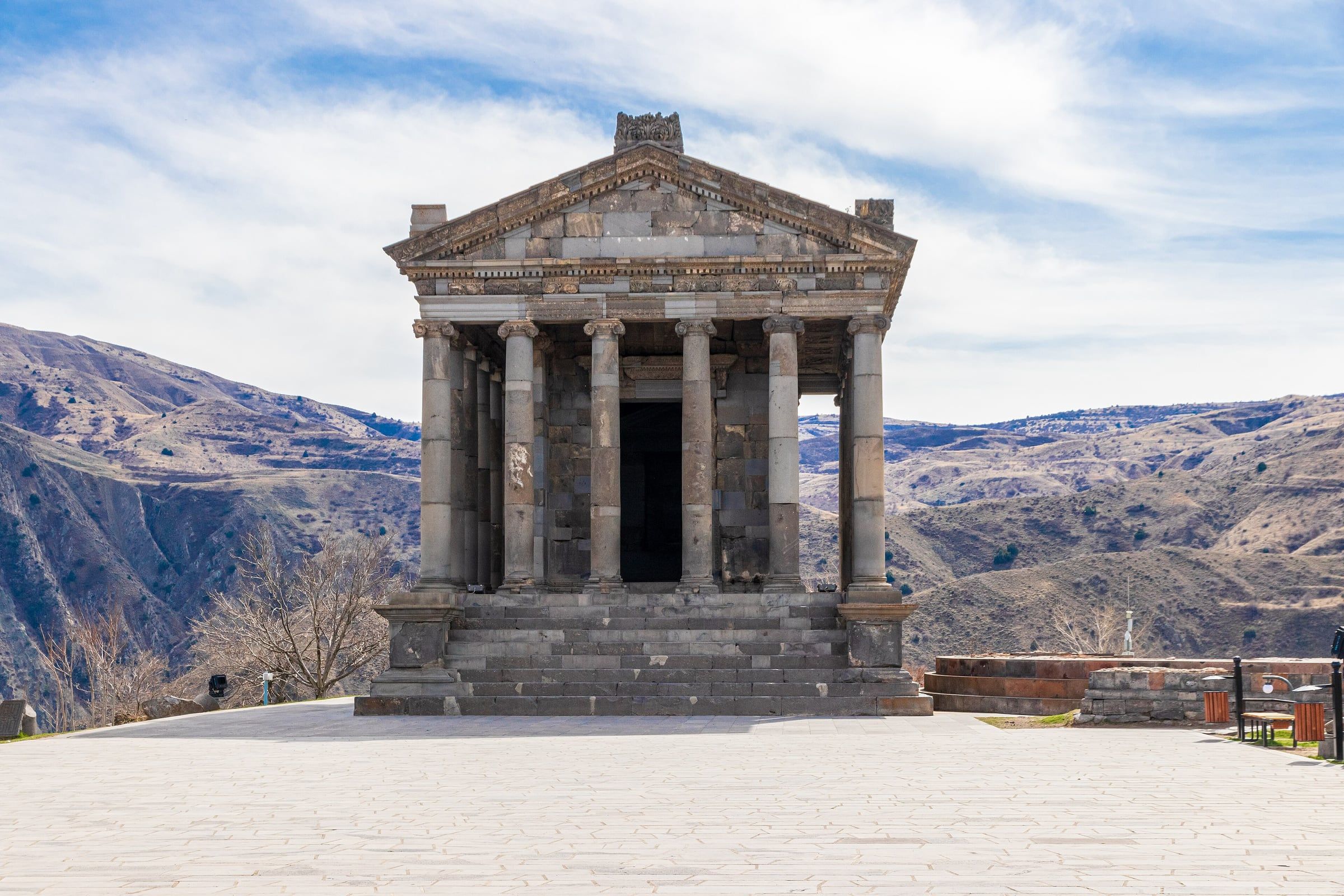
Garni Temple is in Garni village, Kotayk Province, about 30 km east of Yerevan at roughly 1,400 metres above sea level. It is a columned temple of grey basalt, set at the edge of a gorge. The reserve that runs the site calls it the only pagan temple in Armenia to survive to the present day.
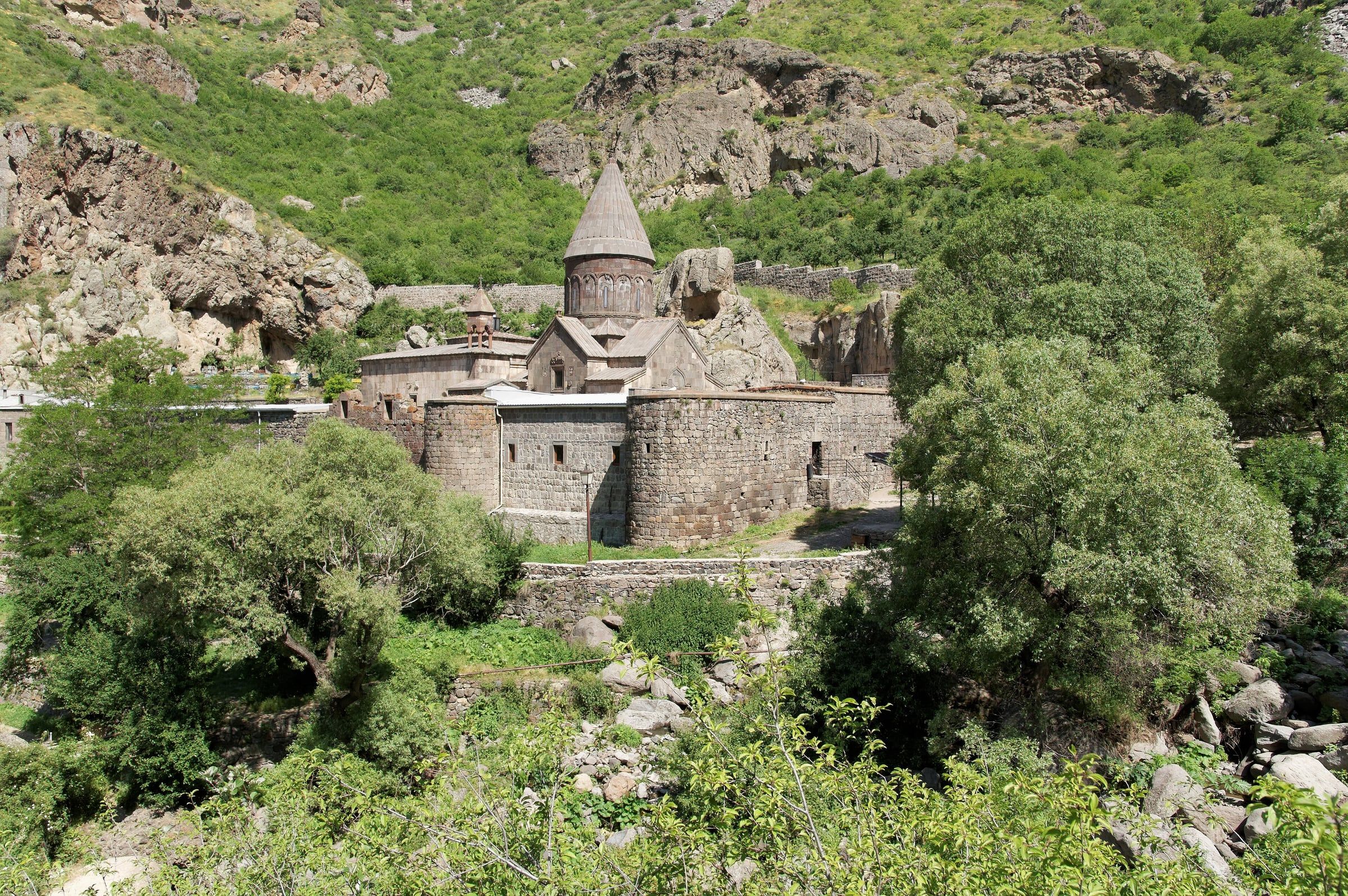
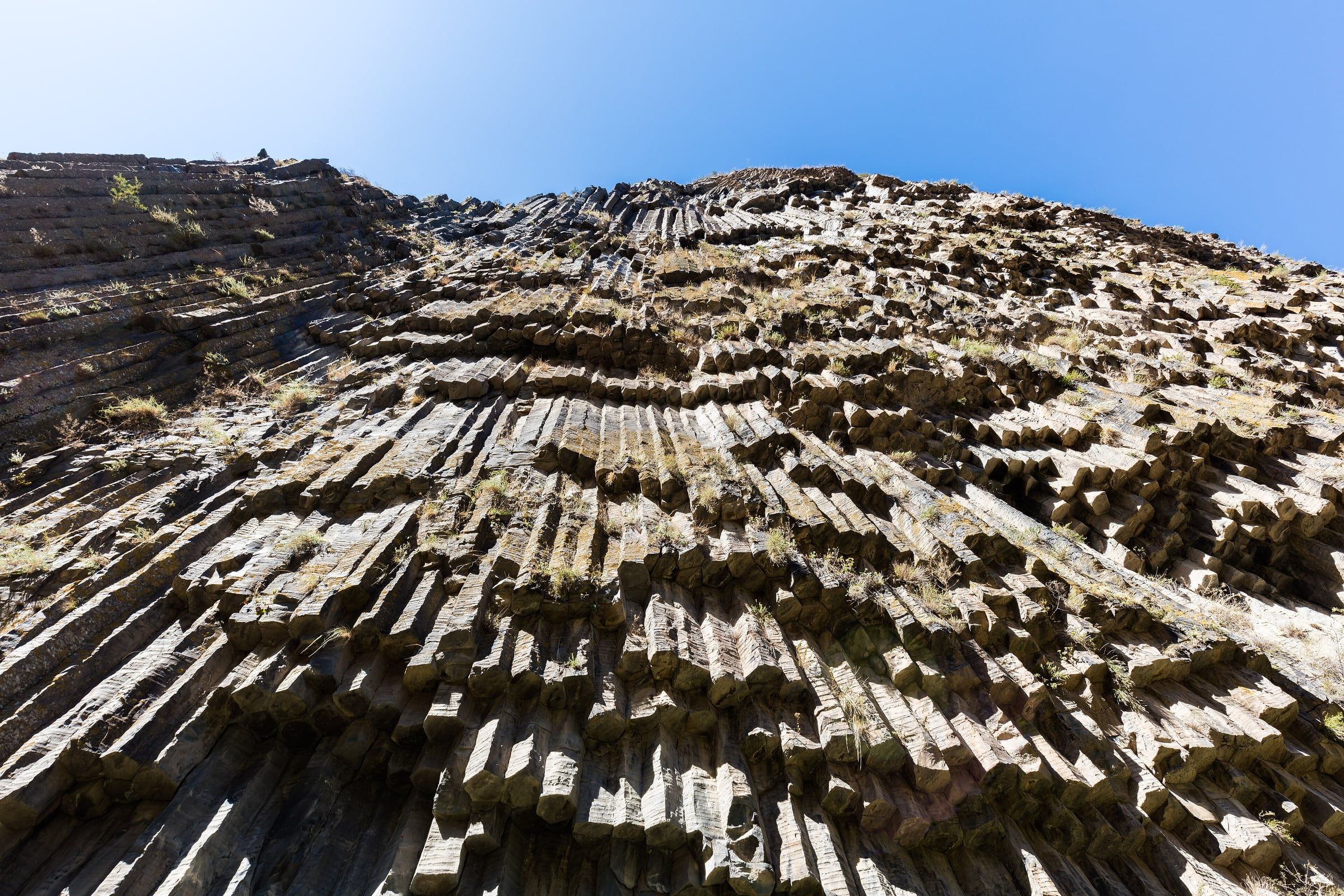
Your ticket covers the temple, the Roman-style bath house and the other remains in the reserve. The Symphony of Stones in the gorge below is a separate stop with its own ticket. Most visitors combine Garni with Geghard Monastery in a half day. The day tours page compares the trips.
History: fortress, temple, earthquake, rebuild
People settled this triangular headland long before the temple. Livius, a scholarly site on the ancient world, describes a Bronze Age settlement protected by massive stone walls. An inscription found in 1963 records a campaign by the Urartian king Argishti I against “the land of Giarniani”, and Wikipedia notes a suggestion that the name Garni comes from an Urartian word for fortress. The Roman historian Tacitus names the fort Gorneae in an account of a dynastic war in the 1st century AD.
The temple is usually dated to 77 AD, in the reign of King Tiridates I. The date rests on a Greek inscription found in 1945 that names the king’s eleventh year. The reserve gives 77 AD, and so do most Armenian scholars. It is not settled. Livius gives the year as 63 or 77, and Wikipedia reports an argument that the inscription refers to the fortress and that the building is a tomb of about 175 AD. The usual dedication is to Mihr, the sun god, although Wikipedia notes one scholar who says there is no direct evidence for that.
After Armenia adopted Christianity in the early 4th century, pagan places of worship were destroyed, yet Garni survived. Why is debated. The reserve offers two explanations: the temple was admired as architecture, or Khosrovidukht, sister of King Tiridates III, asked her brother to spare it. Armenia’s tourism site says it became her summer residence.
On 4 June 1679 an earthquake centred in Garni Gorge brought the colonnade down. The podium, lower walls and column bases stayed standing. Reconstruction began in January 1969 under the architect Alexander Sahinian and was largely complete by mid-1975. The method is called anastylosis, which means rebuilding from the original fallen pieces. A university heritage project notes that some parts, such as a roof arch, are the restorers’ reconstruction rather than surviving fabric. What you see is a real ancient building, put back together in the 1970s.
What you see
The temple. The building stands on a high podium reached by a flight of steps. It has 24 Ionic columns, each 6.54 metres high, with six at each end and eight along the sides. The inner room, the cella, measures about 8 by 5 metres. Two pedestals beside the steps carry a sculpted Atlas, the Titan of Greek myth, who seems to hold the temple up. You can walk all the way round the outside, and the back looks over the gorge.
The bath house. The ruins of a Roman-style bath lie north of the temple. Livius describes a floor heated from below on small brick columns, a system called a hypocaust. The mosaic is the draw. An entrance panel shows sea creatures, Nereids and sailors, and an inner panel shows Thalassa (the sea) and Oceanus. A Greek inscription translates as “without pay, we have been working”, and nobody knows quite what it means. The reserve says the mosaic uses natural stones in 15 colours. Livius and the university project place the baths in the 3rd century AD. One 2014 visitor report describes the remains as enclosed under a cover, so expect to look at the floor rather than walk on it.
Palace, church and walls. Ruins of a royal palace, also from the 3rd century AD, stand near the temple. The foundations of a round church, St Sion, lie immediately west, dated between the 7th and 10th centuries. The fortress wall runs across the headland. Sources measure it differently. The reserve describes a 180-metre wall joining the cliffs, while the university project gives a perimeter of about 314 metres with 14 towers. Treat the figures as approximate and enjoy the setting.
Opening hours and ticket price
Checked October 2026 on the reserve’s own website:
- Hours: Monday to Sunday, 10am to 9:30pm.
- Adult ticket: 1,500 AMD (about €3.70 at the Central Bank of Armenia rate of 404.4 AMD to the euro on 14 October 2026).
- Children, pensioners and students: 750 AMD (about €1.85). Children under 12 go in free.
- Guided tour: 3,000 AMD (about €7.40) in Armenian and 5,000 AMD (about €12) in a foreign language. The reserve asks you to sign up in advance. Its phone numbers are +374 10 545570 and +374 10 587425.
Other sources differ in small ways. A directory listing gives 10am to 9pm, one tour operator gives 10am to 10pm, and one guide reports shorter winter hours of 10am to 5pm. The reserve shows no seasonal change, so we follow its page. Some guides also list 750 AMD for Armenian residents and 1,500 AMD for foreigners, which the reserve’s page does not. Confirm at the gate if the details matter to you.
How long you need
Allow 60 to 90 minutes. A tour operator whose itinerary we checked schedules 60 to 70 minutes at the temple, then 30 to 35 minutes at the Symphony of Stones. That is enough to see the temple, look into the bath house and take in the view, but not to linger.
If you travel independently, you can stay longer. One guide suggests arriving one to two hours before sunset, when the light falls on the gorge. The reserve is open until 9:30pm, so an evening visit is possible, although a tour will not be there then.
The view over the gorge
The temple sits where the headland ends, with the Azat River gorge dropping away behind it. Walk round to the back for the view. The fortress occupies a triangular promontory with cliffs on two sides, a strong defensive position and a long drop beyond the temple.
The basalt columns of the Symphony of Stones are in the gorge below. A local operator’s guide says the viewpoint at the top is enough if you cannot manage the steep path down, which can be slippery after rain.
Facilities and accessibility
The reserve’s page lists no facilities. A directory listing mentions a restaurant or café, a rest area, parking and guide services. A local operator names two restaurants overlooking the site, 7 Qar and Macramé, and says parking costs 100 AMD and is limited near the entrance on busy weekends. We could not confirm toilets, so use the facilities at a stop on the way if you need them.
A flight of stone steps leads up to the temple, and one visitor guide calls them steep. We found no accessibility information. Wear shoes with grip. It is an outdoor site, and one guide advises a hat, sunglasses and sun cream.
Events and busy days
Garni is a place for celebrations. Armenia’s tourism site names it as a popular spot for Vardavar, a water festival held around 14 weeks after Easter, in late June or early July. Wikipedia adds that followers of Armenian neopaganism hold ceremonies at the temple on 21 March, the pagan new year. Expect it to be busier on those dates. See when to visit for the seasons.
Getting there and planning
Garni is under an hour from Yerevan by car. Our getting there guide covers minibuses, taxis and hire cars. If you would rather not organise anything, most half-day tours include Garni, and some include the entry ticket. See day tours for what is covered. The home page has the wider overview.